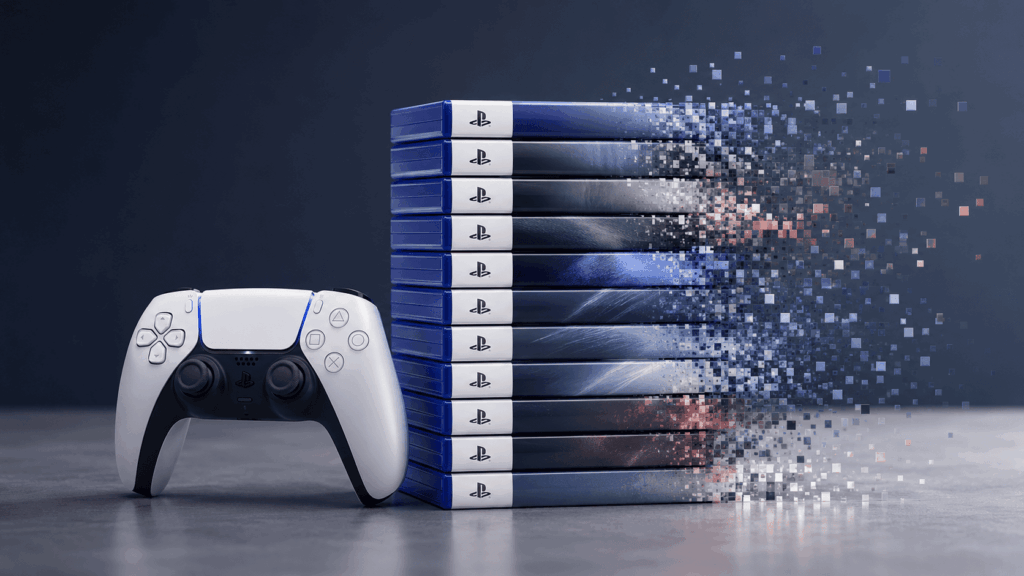

Sony will stop making discs for new PlayStation games from January 2028 I read the announcement three times before it really registered. Anything that has already been released on disc is okay; you will still be able to purchase those copies. But anything after that date is digital only, sold through the Store and wherever else Sony chooses to retail it. It’s been a few days, and I still don’t really know how I feel about it. Mostly nostalgia. A little irritated. Mostly just worn out. Like when something you thought would always be there silently goes away.
The Shelf I Grew Up Building
I still have my first PS1 disc, Crash Bandicoot. The corners of the casing are soft, and the plastic is scuffed to hell by a kid who had no idea how to treat a disc. And from then on I kept adding to that shelf.
It’s not organized or alphabetized; the cases are just stuffed in wherever they fit, and it’s still one of my favorite parts of my apartment. People come over and always end up crouched in front of it, saying, “Wait, you still have this one?” That’s not really something you can do with a library of digital licenses sitting somewhere in an account.
You can’t just hand a folder of downloads to a friend and ask them to do something over the weekend. When you’re done with it, you can’t sell it. You can’t just find it in a box 10 years from now and decide to play it on a random Tuesday, like I did with an old copy of a PS2 game a couple of years ago when I found it while moving apartments and thought, “Why not?”
Own it, don’t rent it—that’s pretty much been my whole approach to this hobby without me ever putting it into words until now. I never thought of it as a philosophy. That’s how it was. You went to the store, paid for it, and walked out with something in a case that was yours in the most literal, boring, physical sense. Apparently that doesn’t work anymore.
I See Sony’s Logic; I Just Don’t Love It
Sony’s decision doesn’t represent a cynical cash grab disguised as progress, nor did it come out of nowhere. For years, physical sales have declined, and the vast majority of people now purchase games digitally. Most people I know under twenty-five have never owned a disc in their life, point-blank. To them, a game stands as just an icon on a home screen; that’s the only idea of ownership they’ve ever known. Honestly, I don’t think that’s wrong; it’s just a different relationship with the hobby than the one I grew up with. Sony’s whole pitch states that they’re simply following where the community has already gone. Good. I mostly accept that argument.
What I don’t buy is that because the majority goes one way, the option has to go for everyone else. Digital and physical co-existed for two decades without anyone forcing a choice on anyone else. Sony isn’t so much catching up with consumer behavior as it is deciding that the smaller group still walking through that door isn’t worth keeping the door open for. At Sony HQ, someone is crunching numbers in a spreadsheet to calculate costs, and I understand; manufacturing and shipping physical media costs money, but just because it makes business sense doesn’t mean it doesn’t take something away from people like me.
It’s convenient for the masses, but not so much for the choices of the rest of us. That’s the deal they’re striking here, whether Sony wants to put it that way or not.
The GTA6 Box That Made It Real
Honestly the thing that made the situation feel real wasn’t even the Sony blog post. It was watching people lose their shit online when GTA6’s “physical” edition was just a box with a download code taped inside instead of a, you know, actual disc. I remember scrolling through that and thinking, Oh, the story is exactly where the industry is going. Sony confirmed it a week later.
That’s not a coincidence; it’s the industry quietly agreeing that the object itself just isn’t worth manufacturing anymore, even as a token gesture for the people who still care about having a physical shelf. It’s a strange kind of bait and switch, selling someone a “physical edition” that has nothing physical in it except cardboard and a piece of paper with a code on it.
It’s the point where all media industries eventually end up. Movie studios slowly ceased Blu-ray production until half your favorite films were no longer available. People were surprised that the DVD mailer lasted that long before Netflix killed it a few years ago. Every time, the rationale is “this is what the data says people want,” which may be true across millions of buyers. Being the underachiever who runs to the store for a disc still hurts.
What “Owning” a Game Actually Means Now
Here’s the part that worries me more than the sentimental shelf stuff, though. Buying a digital license does not mean you own the game; you are renting access to it indefinitely, and that access is entirely at the platform’s whim. The server stopped. Stores shut. Licensing deals expire, and suddenly a game you bought at full price a decade ago disappears when you go to look for it.
I’ve had similar experiences happen with movies before, where I bought something years ago and it just vanished from my library because a licensing deal ended: no refund, no warning, just gone one morning. A disc doesn’t need a server’s permission to boot. It doesn’t matter if the company is still in business, if their servers are still running, or if anyone there even remembers the game; a disc from twenty years ago works exactly the same.
Discs don’t need wifi to know who they belong to.
Sony is also closing the PS3 and Vita stores around the same time, which makes the point even clearer. When a digital storefront closes, whatever you “bought” through it becomes unreachable. This isn’t some hypothetical slippery slope I am inventing to make a point. That’s a literal paragraph in the same announcement, right next to the disc news, like an afterthought. For anyone who bought digital games on those systems, it’s the whole ballgame. You paid real money for something, and now there is no store, no way to redownload, and nothing. Whatever you have already installed will remain usable until the console itself fails.
Not Just An American Living Room
And this situation has important implications outside the US and a handful of other wealthy markets. There are still many places in the world that are very dependent on physical media, either because of the reliability of the internet, the cost of storage, or simply because of habits developed over decades. A decision that seems perfectly reasonable in a country with fast broadband everywhere looks a whole lot more complicated in a country without that luxury. I doubt that these announcements discuss this enough, and it’s important to remember that the phrase “most players prefer digital” carries significant implications depending on which players you actually count.
Where I’ve Landed
I’m not so naive to think that being annoyed about this decision will change anything at the corporate level. Physical media’s been shrinking for a decade, and one blog post from Sony is not going to reverse a trend that’s been going that direction the whole time. But there’s a difference between accepting the direction of an industry and acting as if it costs nobody anything.
It’s resale value. It costs the option to lend a game to a friend or borrow one instead of buying it. It costs preservation over time. And it costs that very physical connection to something you cared enough to actually pay for, the kind of thing that becomes a shelf full of memories instead of a login screen full of purchase history.
So I’m probably going to be a bit more deliberate about which games I actually buy on disc between now and that January 2028 cutoff. Not because I think it will change the industry—it won’t—but because it still means something to me. Call it stubbornness, call it sentimentality—I don’t care what you call it.
If you’ve got a shelf too, like me, don’t wait around for this one. Whatever you want sitting there in ten years, take it while it’s still an option. After the cut-off, everything will be downloaded.
This is just my take as someone who’s been collecting PlayStation games since the PS1 days, not an official statement from Sony or anyone else.
http://www.take2games.com/