
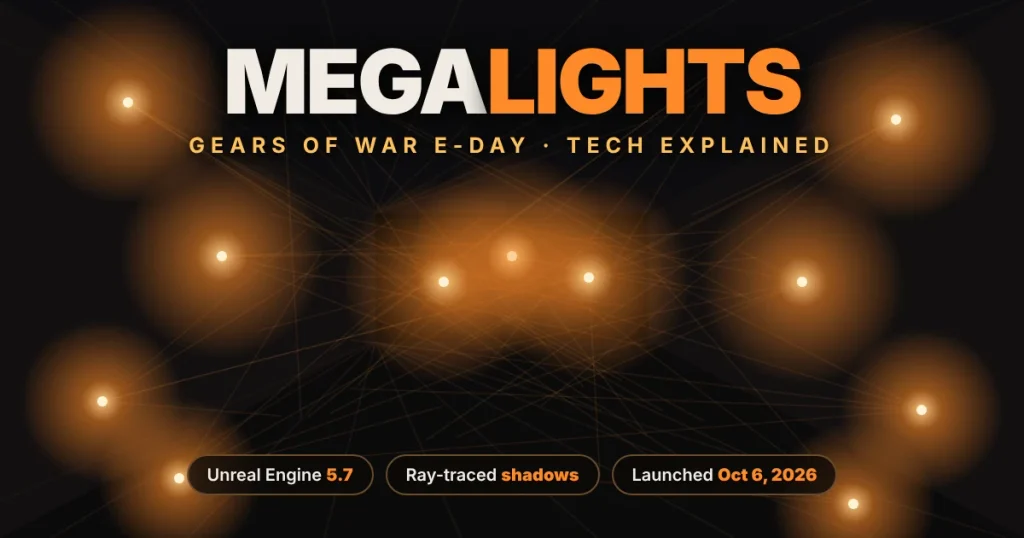
Original graphic by GamingMuzz, not official artwork.
Written by the GamingMuzz team. Last updated: October 20, 2026 Update note: The game launched two weeks ago, so patches and performance fixes may change some details below.
Picture one grocery store, hundreds of lights, and every light casting a shadow. On an Xbox Series X, at 60 frames per second. That demo introduced Gears of War E-Day MegaLights to the public in June 2026. It sounded too good for a console.
E-Day launched on October 6, 2026, so we can finally ask the real questions. What does the tech do? What does it cost you? And does your PC even qualify?
Spoiler: older GTX cards don’t. Here’s what the sources say, with dates.
Key Takeaways
- MegaLights is an Unreal Engine 5 system for placing many dynamic, shadow-casting lights without a matching performance bill.
- The Coalition showed it at 60 fps on Xbox Series X in June 2026. The game launched October 6, 2026.
- Console modes render below 1080p internally, per Digital Foundry as relayed by WindowsForum.
- Every minimum PC graphics card on the listings supports hardware ray tracing, so GTX cards are out.
- Tom’s Hardware found an RTX 3060 needs upscaling and lower settings to reach 60 fps at 1080p.
What Is Gears of War E-Day MegaLights, in Plain English?
Quick answer: MegaLights is Unreal Engine 5’s lighting system for lots of dynamic lights that all cast shadows. It samples the lights that matter to each pixel, then cleans up the noise.
Epic’s documentation calls it a stochastic direct lighting technique. Translation: each pixel asks only the important lights for a vote, instead of polling every light in the room.
Why should a player care? Dark horror rooms run on small, moving lights. Flashlights, muzzle flashes, and fires all push shadows around, and MegaLights lets artists place many of them.
The Coalition said the system helped create darker spaces and stronger contrast for the game’s horror tone. 80 Level’s own analysis called the lighting E-Day’s most consequential technical accomplishment. That is one outlet’s opinion, but it matches what the developers say.
My read: this is the right tool for the right game. Dark corridors need many small lights, not one big sun.
Hundreds of Lights: What Gears of War E-Day MegaLights Delivers
Here are the facts that held up across more than one source. Dates are when each source published.
| Fact | Detail | Source |
|---|---|---|
| Engine | Unreal Engine 5; MegaLights debuted in Unreal Engine 5.7 | Wikipedia, Wccftech |
| Demo claim | Hundreds of shadow-casting lights in one store scene | Wccftech (Jun 17, 2026), Overclock3D (Jun 18, 2026) |
| Console target | 60 fps on Xbox Series X | Wccftech, Overclock3D |
| Developers | The Coalition and People Can Fly | Wikipedia |
| Partners | Epic Games on lighting; Nvidia on PC optimization | Overclock3D, Wikipedia |
| Platforms | Xbox Series X | S and Windows, as of Oct 20, 2026 |
The Coalition demoed the system at State of Unreal 2026. Studio technical director Kate Rayner presented it, according to Wccftech.
Critics have responded well. OpenCritic showed a top critic average of 85 across 116 reviews, with 90% recommending the game. That page was last modified October 19, 2026.
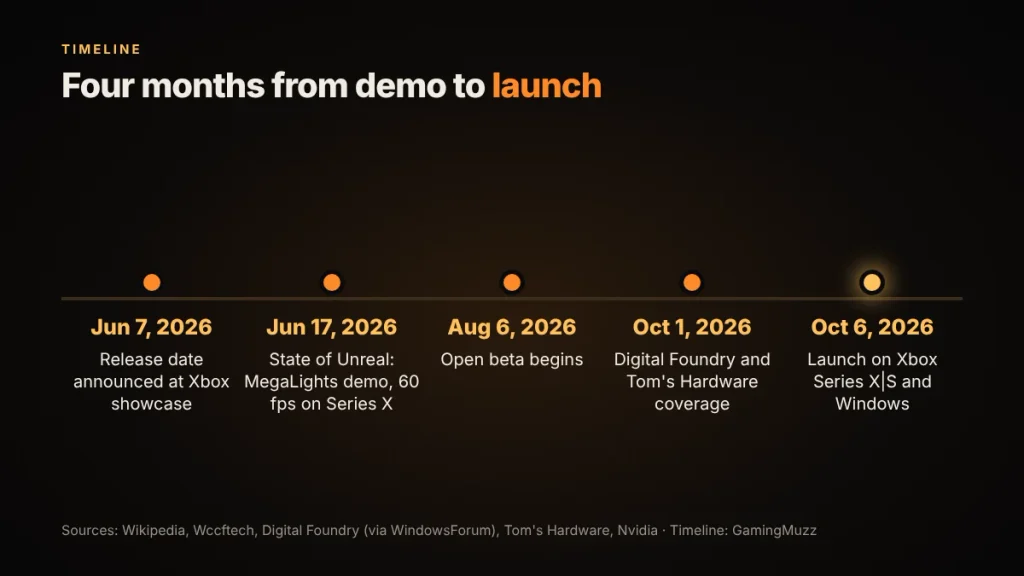
Timeline by GamingMuzz. Sources: Wikipedia, Wccftech, Digital Foundry, Tom’s Hardware, Nvidia.
From announcement to launch took four months. Not bad for a tech story that began as a demo clip.
Region note: Game Pass access and pricing vary by country, and I didn’t verify each market. As of October 20, 2026, the game isn’t on PlayStation. Sources say it isn’t coming to PS5 at launch.
How Gears of War E-Day MegaLights Works Under the Hood
Epic’s docs describe the process in five steps. I’ve kept them in order.
- Each pixel traces a fixed number of rays toward important lights.
- Short screen-space traces catch small details first.
- Rays that miss continue into the Ray Tracing Scene, built from simplified Nanite meshes.
- Ray guiding sends more samples toward lights likely to matter, and fewer toward blocked ones.
- A denoiser rebuilds a clean image from the noisy samples.
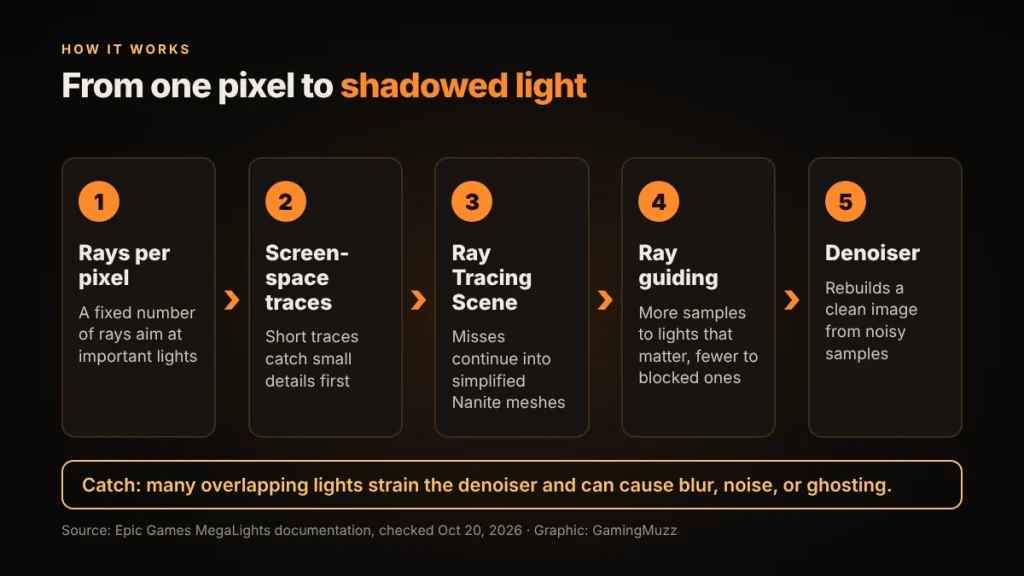
Flow graphic by GamingMuzz. Source: Epic Games MegaLights documentation, checked October 20, 2026.
Here’s the catch. Epic warns that many overlapping lights per pixel strain the denoiser, which can cause blur, noise, or ghosting. Epic also says cost depends mainly on internal resolution and the number of samples per pixel.
Epic recommends pairing MegaLights with hardware Lumen, so both systems share the ray tracing overhead. E-Day does that, since it uses hardware Lumen, per Wikipedia. Read the full MegaLights documentation if you want the engine-level detail.
My read: the denoiser is the part to watch. If you ever spot smeary shadows in a crowded fight, that’s probably where the compromise lives.
Console Reality: Gears of War E-Day MegaLights on Xbox
Sixty frames per second is real, but it costs pixels. Digital Foundry’s measurements, relayed by WindowsForum on October 1, 2026, show the trade clearly.
| Mode | Series X | Series S |
|---|---|---|
| Performance | 60 fps, about 936p internal | 60 fps, about 576p internal |
| Balanced | 40 fps, about 1000p internal | 40 fps, about 648p internal |
| Quality | 30 fps, about 1152p internal | 30 fps, about 792p internal |
These are internal resolutions before upscaling, not output resolutions. Digital Foundry also reported CPU-bound frame-time spikes in open areas, and rockier performance on Series S.
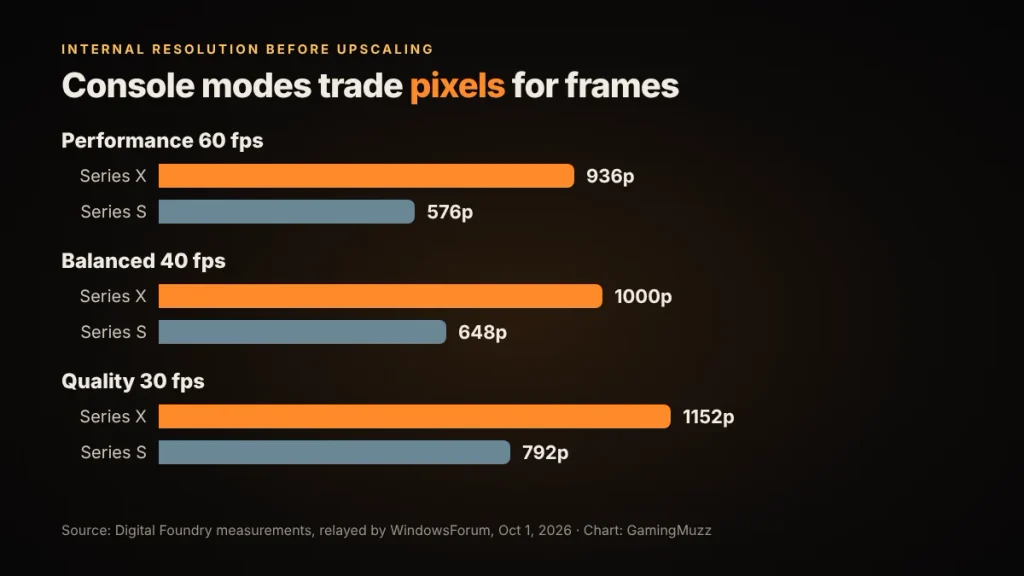
Source: Digital Foundry measurements, relayed by WindowsForum, October 1, 2026. Chart by GamingMuzz.
My read: the 60 fps mode is the headline, yet the Quality mode shows the real price. Even the sharpest console mode renders around 1152p. That’s the cost of ray-traced shadows from every important light.
Does Your PC Run Gears of War E-Day MegaLights?
Short answer: only if your graphics card supports hardware ray tracing. Three listings (NZXT citing Steam, Corsair, and GameSystemRequirements) agree on the E-Day system requirements below.
| Part | Minimum | Recommended |
|---|---|---|
| OS | Windows 10 64-bit (22H2) | Windows 11 64-bit (25H2) |
| CPU | Ryzen 5 2600X, Core i7-6850K, or Core i5-10400 | Ryzen 5 5600 or Core i5-11600K |
| RAM | 12 GB | 16 GB |
| GPU | RTX 5050, RTX 2060, RX 6600, or RX 9060 | RTX 5060, RTX 3060 Ti, RX 6700 XT, or RX 9060 XT |
| Storage | SSD required | SSD required |
As of October 20, 2026. Listings differ on the install size, so check the Steam page for the exact number.
Notice what’s missing: no GTX card, and no Radeon RX 5000 card. NZXT says ray tracing is required even at the minimum, since those cards lack the hardware. It’s the same wall other ray-tracing-only games have built.
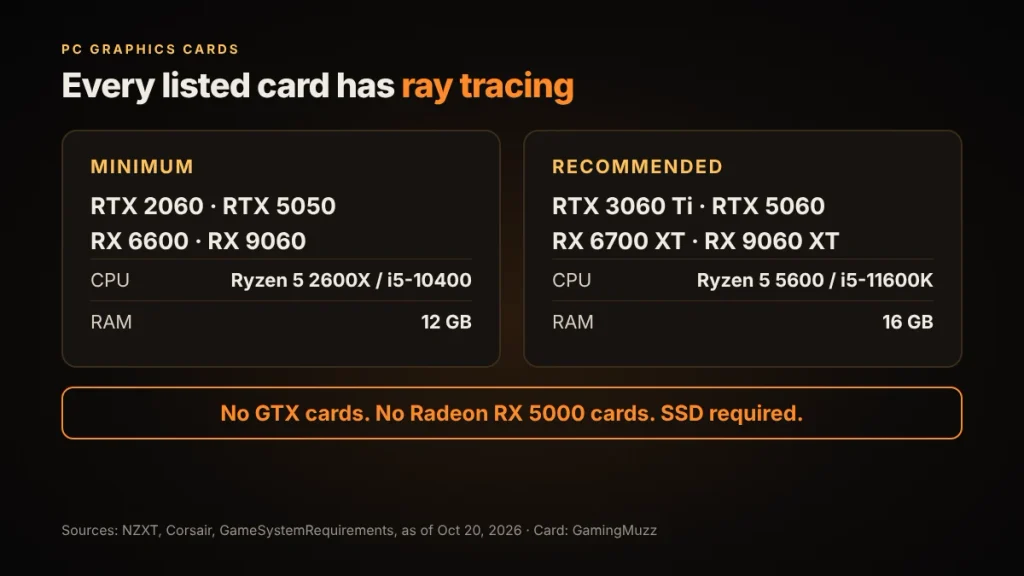
Card by GamingMuzz. Sources: NZXT, Corsair, GameSystemRequirements.
Real tests tell a harsher story. Tom’s Hardware, on October 1, 2026, said an RTX 3060 falls well short of 60 fps at native 1080p Ultra. Medium settings with DLSS Quality cleared 60 fps.
It named the RTX 5060 as the starting point for a roughly 60 fps native 1080p Ultra experience. DSOGaming also found the RTX 2080 Ti struggled at 1080p Ultra. It added that an RTX 4090 can’t hold 60 fps at native 4K.
Tuning Gears of War E-Day MegaLights Performance on PC
You have fewer dials than you’d like. I couldn’t find a dedicated MegaLights toggle in the settings coverage, so here’s what the reports do support.
- Use upscaling. DSOGaming lists DLSS 4.5, FSR 4, and XeSS 3.0t support. Epic says MegaLights cost tracks internal resolution, so this is your biggest lever.
- Watch your CPU. FPS Review summarized a Tom’s Hardware test of 25 CPUs. A Ryzen 7 9800X3D ran 42% faster than a Ryzen 5 7600X at 1080p High.
- Skip RTX Mega Geometry on small VRAM. Nvidia says it needs an RTX card with at least 12 GB. Tom’s estimated roughly a 10% cost.
- Expect smooth shaders. DSOGaming says shaders compile on first launch, so shader stutter was absent. A few traversal stutters did appear.
My read: treat it as a CPU-and-resolution game, not just a graphics card game. That’s unusual for Unreal Engine 5, and it’s worth knowing before you upgrade the wrong part.
Reported, Not Confirmed
These claims come from one outlet or conflict with other sources. I couldn’t verify them against a primary source.
- Tens of thousands of lights across the city. Wccftech reported this from the State of Unreal talk. No second outlet repeated it.
- MegaLights speed-up since 2024. Digital Foundry reportedly said the developers more than doubled its speed. I only saw this through WindowsForum.
- Light counts. Nvidia’s article says up to 100 light sources, Digital Foundry (relayed) says thousands, and the Coalition demo said hundreds. These likely measure different things, so I left out a single number.
- No MegaLights toggle. DSOGaming didn’t mention one. I can’t prove none exists.
- Series S stalls. One report mentions pauses near a second. The cause isn’t known.
Quick Questions Answered
Can I turn MegaLights off?
I couldn’t find a toggle in the coverage I read. Console coverage says ray tracing has no off option.
Do I need an RTX card?
You need ray tracing hardware, not necessarily Nvidia. The minimum list includes AMD’s RX 6600 and RX 9060.
Is this an Nvidia feature?
No. Nvidia’s own article credits MegaLights as an Unreal Engine feature. Nvidia’s contribution is RTX Mega Geometry and DLSS.
Is E-Day on PlayStation 5?
Not at launch. Sources list Xbox Series X|S and Windows.
How I Checked This
This article is based on official sources and outlet descriptions, not hands-on testing.
- Engine facts: Epic Games’ MegaLights documentation.
- Launch and platforms: Wikipedia and Nvidia’s launch post, dated October 6, 2026.
- Demo claims: Wccftech and Overclock3D, June 2026.
- Console modes: Digital Foundry, through WindowsForum, October 1, 2026.
- PC hardware: NZXT, Corsair, GameSystemRequirements, Tom’s Hardware, and DSOGaming.
- Not opened: Steam’s live store page and Digital Foundry’s original article.
Last Word
Gears of War E-Day MegaLights is a real step forward for dark, moving, shadow-heavy lighting. It also draws a hard line: no ray tracing hardware, no game. If your card has it, you’re in for a treat.
Sources: Epic Games; Wikipedia; Nvidia; Wccftech; Overclock3D; Digital Foundry via WindowsForum; Tom’s Hardware; DSOGaming; FPS Review; 80 Level; OpenCritic; NZXT; Corsair; GameSystemRequirements.